I started with reconstruction: take a few photos of a LEGO model and recover its parts, colors, positions, and orientations.
Entries from March 28–29, 2026, edited retrospectively from my project logbook on October 30, 2026.
2026-03-28: First end-to-end pipeline
Setup. Generate random assemblies, render four views, and train a model to predict the bricks one at a time. Procedural generation gives me the brick list for every image without labeling photos by hand.
- Data: 12 common brick and plate types, 33 colors, four rotations around the vertical axis.
- Images: a PIL software renderer, with four roughly evenly spaced viewpoints.
- Model: a ResNet-18 image encoder and a six-layer transformer decoder. Each decoder step predicts one brick’s part ID, position, rotation, and color.
Results. Training ran on CPU. Loss fell from 24.8 to 24.4 over two epochs on 32 samples. Inference exported LDraw files that viewers could parse.
That verified the pipeline ran, not that it reconstructed the inputs correctly.
Next check. Overfit one assembly. If the model cannot memorize one example, more training data will not fix it.
2026-03-29: Start and stop were the same token
Failure. Training loss could reach zero, but generation returned no bricks. The decoder started from an all-zero token, identical to its end-of-sequence token.
Fix. Give the decoder distinct <bos> and <eos> tokens for the beginning and end of a sequence.
Test. I used a two-piece model made in BrickLink Studio: a red 2×3 plate with a blue 1×3 brick on top.
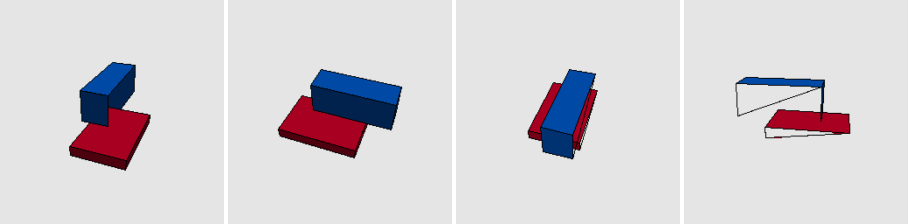
From training step 100 onward, generation matched both pieces’ part IDs, colors, and positions exactly. Recorded brick accuracy and voxel IoU were both 1.0.
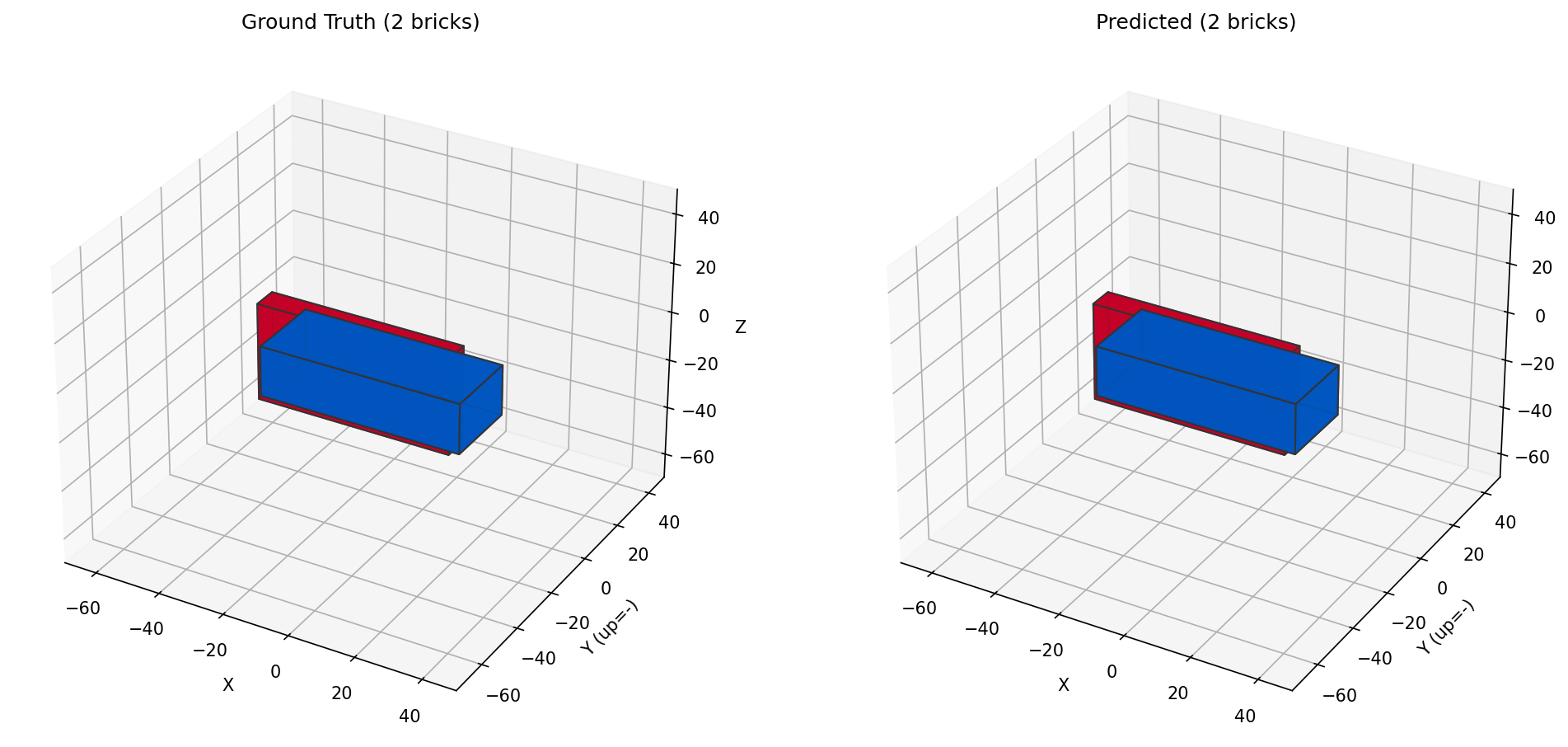
This was memorization of one example, not a generalization result.
Data problem. Opening the procedural assemblies in Studio exposed illegal intersections. The generator checked collisions at stud level, not across the full brick volumes.
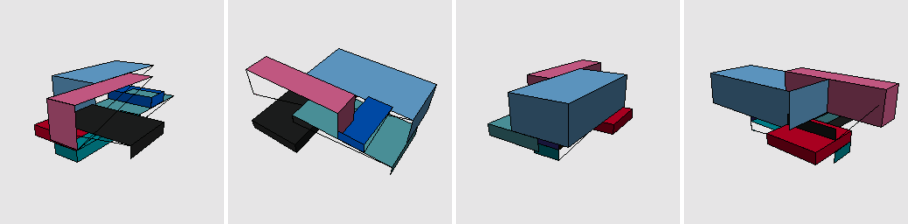
Decision. Use existing LDraw models from the community’s Official Model Repository, or models made in Studio, instead of building a separate construction validator.
Part of the LEGO project. Source: project logbook entries for March 28–29, 2026.